Hot: Skin Analyzer PDT Skin Machine Hair Growth Device Home Phototherapy

PUVA is the phototherapy most likely to be dropped in a cost review and the one most likely to be missed when it is gone. It carries a documented dose-dependent skin cancer risk, requires a psoralen, and demands more supervision than narrowband UVB - and it still works on cases where NBUVB does not.
The question for a modern clinic is not whether PUVA is safe, but which indications justify keeping it, and what the operating requirements are if you do.
UVA penetrates deeper than UVB, and psoralen makes the skin more responsive to it. That combination matters in thicker plaques, in palmoplantar disease where the stratum corneum defeats UVB, and in some lymphoproliferative conditions where the deeper penetration changes the response.
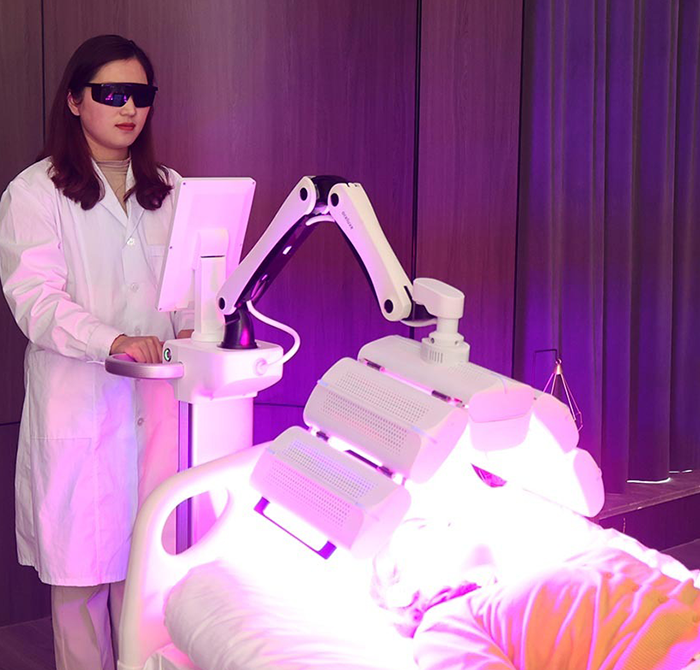
PUVA is a specialist tool: the ceiling, the interval and the cumulative total are clinical decisions.
The squamous cell carcinoma signal in PUVA cohorts is dose-dependent and persists after treatment ends. That single fact drives every design decision: a lifetime cumulative dose ceiling, a documented total per patient, shielding of high-risk sites, and a lower threshold for switching modality.
It also drives the consent conversation. PUVA is not a treatment a patient should meet for the first time on the day it starts, and the lifetime dose record should be explained as a resource rather than a rule - it protects the next course, not just this one.

PUVA is supervision-heavy: the interval, the psoralen dose and the cumulative total are all clinical decisions, not scheduling details.
For most psoriasis, vitiligo and eczema lists, narrowband UVB delivers a comparable response with a better safety profile, no drug, and simpler operations. A clinic that runs PUVA for the whole list is carrying the ceiling and the paperwork for no clinical gain.
The cost comparison rarely decides it, because the devices are similar in price. What decides it is the caseload: if fewer than a handful of patients a year genuinely need PUVA, the honest options are a referral pathway or a shared arrangement with a nearby centre.
Topical psoralen avoids systemic exposure and is used in palmoplantar disease and some localised plaques. It reduces, but does not remove, the cumulative dose question, and it demands more operator attention because the application has to be even - a patchy application produces a patchy burn.
Where a clinic wants the depth of UVA for hands and feet without the systemic burden, topical PUVA with a hand or foot unit is a reasonable middle path, and it is the version most often retained when a full PUVA service is closed.
Three questions settle it for most services. Which indications genuinely need UVA? How many patients a year is that? Can the service meet the supervision and record requirements every session, not on good weeks?
If the answers point to keeping PUVA, write the cumulative dose ceiling, the shielding policy, the interval rule and the review cadence into the service protocol, and make the total a field the whole team reads before treating. If they point to closing it, write the referral pathway instead - and make sure the clinic's NBUVB capacity can absorb the patients.
Reviewing your modality mix? Ask for the PUVA operating checklist and cumulative dose sheet.
【Editor】admin
 Address
2nd Floor, 1-101,Building 6, Xuzhou , LIANDO U Valley, 6# Leye Road, Damiao Street, Jiangsu Province, China
 Email
 Tel/Whatsapp
+86 18914846950
 Facebook
18914846950