Hot: Skin Analyzer PDT Skin Machine Hair Growth Device Home Phototherapy

Every phototherapy service eventually gets the question: does this cause skin cancer? The honest answer is more specific than yes or no, and it depends heavily on which phototherapy, at what cumulative dose, in which patient.
Clinics that can answer precisely keep patients in treatment. Clinics that answer vaguely lose them at week six, usually to an internet search that is worse than the truth.
Phototherapy is not one exposure. Narrowband UVB, broadband UVB, targeted 308 nm, PUVA and visible-light LED therapy sit at different points on the risk spectrum, and a single answer covering all of them is either frightening or falsely reassuring.

Naming the modality is the first thing a risk conversation has to do.
The large psoriasis cohorts that followed patients for years found that narrowband UVB did not carry the clear excess of skin cancer seen with PUVA. The complication is confounding: many of those patients had earlier PUVA, methotrexate or ciclosporin, all of which complicate attribution.
The practical reading is that narrowband UVB is regarded as a low-risk modality, not a no-risk one, and that the cumulative dose should still be recorded as if it mattered - because for PUVA it demonstrably does, and because the patient's next clinician will need the number.
Two clinics can deliver the same number of sessions with very different total energy. The difference comes from the ladder, the lamp, the distance and the number of restarts. That is why a session log that records delivered dose, not prescribed dose, is a safety document rather than an administrative one.
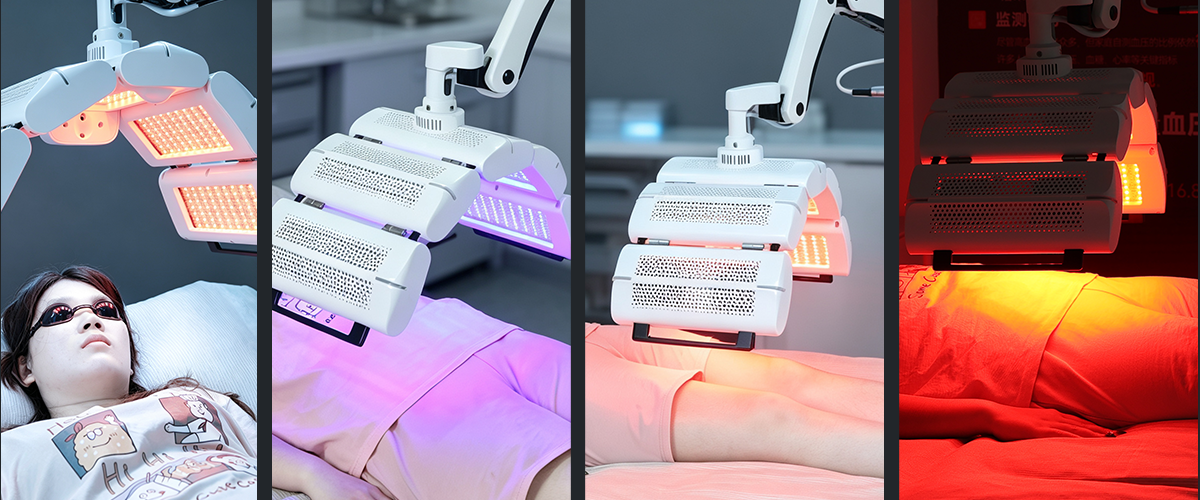
Different formats, different dose profiles: a risk conversation has to name the modality, not just the word phototherapy.
The strongest historical signal is genital squamous cell carcinoma in men treated with PUVA, and it changed practice: shielding of the genitalia during whole-body phototherapy is now routine in well-run services. It belongs in the policy, not in the individual clinician's habits.
The same logic applies to the face in patients with a history of facial lesions, to the ears in outdoor workers, and to any area with field change. Shielded fields should be recorded, because a shield that is assumed but not written is a shield that stops being used.
Four groups deserve an individual decision rather than a protocol. Patients with a previous skin cancer, patients on long-term immunosuppression, patients with a genodermatosis carrying high cancer risk, and patients who have already accumulated a large PUVA dose.
None of these is an automatic exclusion. Each is a reason to narrow the field, lower the cumulative dose, shorten the course and increase surveillance - decisions that are much easier to make when the record shows how much ultraviolet the patient has already received.
Use the structure rather than the statistic. Say which modality, say what the data show for that modality, say what the clinic does to limit dose and shield high-risk areas, and say what monitoring is in place. A patient who hears a plan stops treating the question as an unresolved risk.
Avoid two failure modes: claiming phototherapy is entirely without risk, and implying that the risk is comparable across all phototherapy. Both are common, and both get corrected by the first patient who reads something else.
Want the cumulative dose sheet and shielding policy we give clinics? Ask our clinical support team.
【Editor】admin
 Address
2nd Floor, 1-101,Building 6, Xuzhou , LIANDO U Valley, 6# Leye Road, Damiao Street, Jiangsu Province, China
 Email
 Tel/Whatsapp
+86 18914846950
 Facebook
18914846950